Blog Posts:
Advanced Forecasting With AI: Skipping the Middleman
AI forecasting sounds like an easy win until you deploy it and realize the problem was never the model. This article makes the case that conversation signals are the most reliable input for AI-driven forecasting and that most teams fail at implementation not because of the technology, but because their data foundation cannot support it.
The piece draws a clean line between two scenarios: teams where AI forecasting compounds advantage, and teams where it confidently amplifies existing inaccuracies. The difference is not the AI layer. It is whether rep-submitted data has been replaced by signal-based inputs, call activity, engagement patterns, deal momentum, before the model ever runs. The article walks through which conversation signals carry the most predictive weight, how to sequence the build so AI forecasting runs on clean inputs from day one, and why most teams skip the foundation work and end up with a faster version of the same broken number.
For RevOps leaders who want to move from rep-submitted gut calls to something the CFO will actually trust, read the full article here.
The GTM Context Graph: Why Revenue Platforms Are Built on Context
Most GTM platforms store events. A context graph connects those events into relationships and tracks how they change over time and that distinction is where AI in revenue either works or fails.
The article opens with a pointed observation from Gartner's May 2026 survey: 31% of CSOs cited difficulty proving AI ROI as a top challenge. RevSure's argument is that this is a context problem, not an AI problem. An agent that sees a pricing-page visit without the six months of account history behind it will misread the moment and no model tuning fixes missing memory. The piece explains what a context graph actually does: connects buyers, signals, stages, and outcomes into one structure so AI can reason about what an event means rather than just recording that it happened. It distinguishes context graphs from knowledge graphs (static facts vs. behavioral change over time), and from CRMs and data warehouses (event storage vs. interpretation). It also makes the business case: one published result showed roughly $100K in spend reallocated across five verticals producing 105 additional net-new opportunities because the system could see which motions were actually moving pipeline and which were taking credit for it.
To understand why context is the missing layer between AI deployment and AI ROI, take a closer look at the full article here.
How to Align Sales and Marketing on Lead Handoffs: A Practitioner's Guide
Lead handoffs are rarely a relationship problem between sales and marketing. They are almost always a process problem and this practitioner's guide treats them that way.
- Why handoffs break: five root causes, from slow response time to missing audit trails, that turn a process problem into a pipeline problem.
- Five shared metrics: one unified definition for speed to lead, acceptance rate, MQL to SQL, meeting show rate, and first response time because most sales-marketing friction starts with each team measuring the same thing differently.
- A rollout plan that actually works: a three-stage sequence from test environment to full deployment, with the Uber for Business result as proof 68% faster deal velocity, 53% higher win rates, 95% reduction in MQL time-to-assignment.
For the full routing logic, SLA tracking framework, and rollout plan, explore the complete guide here.

Podcast Episodes:
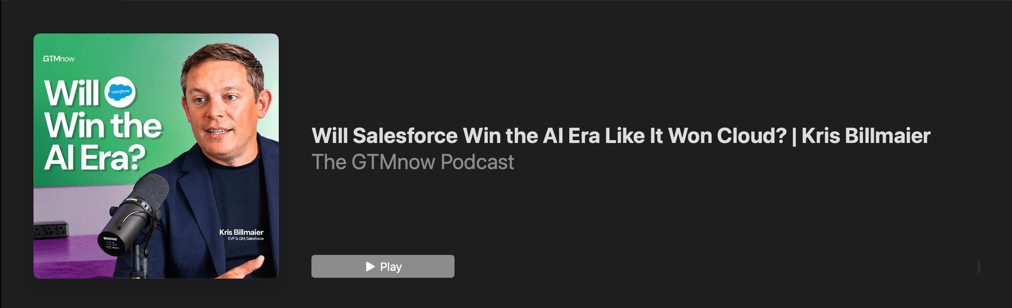
Will Salesforce Win the AI Era Like It Won Cloud? | Kris Billmaier
Is Salesforce the dominant platform in the AI shift, or the incumbent about to be disrupted? This 44-minute episode of The GTMnow Podcast puts that question directly to Kris Billmaier, EVP and GM of Agentforce Sales at Salesforce, in a conversation hosted by Sophie Buonassisi at Salesforce Tower.
Kris makes the case that CRM is becoming "agentic revenue orchestration" and that the category needs a new name — one where the platform surfaces headlessly inside Slack, ChatGPT, Gemini, and wherever sellers actually work. He shares internal numbers that are hard to ignore: an engagement agent that worked leads Salesforce had always ignored and generated over $100M in pipeline in eight months. The episode also covers why 60% of seller time still goes to non-selling work and which agents remove it, how one leader manages 100 reps plus the equivalent of 400 agents, why Salesforce is hiring more sellers (not fewer), how the Momentum acquisition introduced "memory fragments" that cut an 8,000-word meeting to the 800 words that matter, and how hiring has shifted from "what did you do" to "how do you build."
For a direct, insider account of what agentic revenue execution actually looks like at scale, listen to the full episode here.
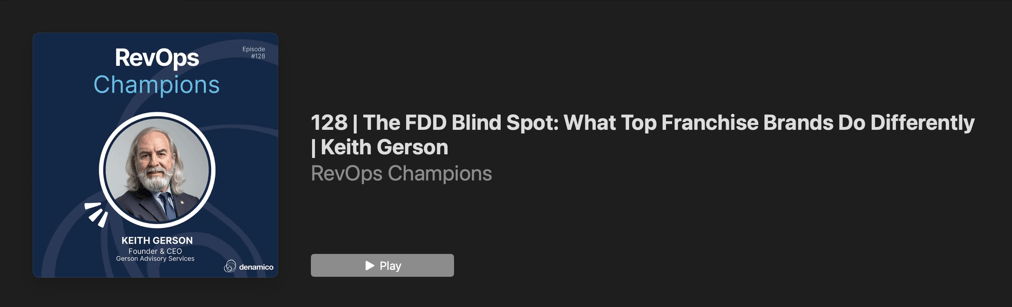
The FDD Blind Spot: What Top Franchise Brands Do Differently | Keith Gerson
Most franchise brands measure the wrong things, reward the wrong behaviors, and then wonder why their best franchisees are also their most frustrated ones. Keith Gerson, CFE with 50 years in franchising and more than 1,500 brands advised joins Brendon Dennewill to name the blind spots that quietly separate the brands that scale from those that stall.
The conversation is operationally specific in a way that translates directly to any revenue leader thinking about multi-unit or distributed GTM systems. Keith covers why unit-level profitability is the only metric that actually predicts long-term franchise success, how to read the FDD as competitive intelligence rather than a legal requirement, and why royalty structures that punish growth rather than reward it are one of the most common and correctable causes of franchisee disengagement. He also addresses where AI earns its keep in franchising not in dashboards that describe what happened, but in systems that can predict which franchisees are at risk before the behavior shows up in the numbers.
For a sharp, experience-backed conversation on performance intelligence and revenue system design at scale, access the full episode here.
Better Data Drives Better Targeting
When should a workflow be automated, and when does human intervention create more value? This 45-minute episode of Deconstructing Data tackles that question directly, with host Jessie Lizak and guest Ashley Moser, Co-Founder and CCO of MelodyArc, exploring how organizations can combine AI, data, and human expertise to make targeting decisions that actually hold up.
Ashley's framing is practical and grounded: not every data workflow needs to happen in real time, not every signal needs an automated response, and the teams getting the most out of AI are the ones that have been deliberate about where human oversight sits in the loop. The conversation covers how to transform qualitative signals into structured, actionable data, how businesses can use real-time information to sharpen targeting and customer experience, and how to capture institutional knowledge from people and embed it into future workflows. Tools discussed include MelodyArc, Cursor, and H2O AI.
For a data-forward conversation on the human-AI balance in GTM execution, tune in to the full episode here.

Webinars:
Your Pipeline Runs on Something You Can't Forecast
By: RevGenius
Your pipeline looks healthy on paper. Then the quarter closes and the number is soft and nobody saw it coming because the dashboard was measuring the wrong things. This session from RevGenius addresses the hidden layer underneath pipeline that determines whether deals actually close: buyer relationships, engagement depth, and the trust signals that CRM stages were never built to capture.
The session examines why traditional pipeline metrics give revenue leaders a false sense of confidence, what the signals are that actually predict close rates before they show up in stage movement, and how GTM teams can build the operational infrastructure to track and act on those signals consistently. For RevOps leaders who are tired of explaining quarter-end surprises, this is the conversation that reframes where the forecasting problem actually lives.
Date: August 27, 2026 | 12:00 PM EST | 9:00 AM PT | Free | Virtual
To understand what your pipeline is actually running on, register for the full session here.
The RevOps Guide to Events: Before, During & After
By: RevOps Co-op
Events are one of the most expensive GTM motions a company runs and one of the most poorly operationalized. This session from RevOps Co-op, in partnership with Mobly, walks through what Operations should own before, during, and after an event to turn booth presence and conference attendance into pipeline that actually closes.
The session covers how to build pre-event infrastructure that captures leads cleanly and routes them the moment they walk away from the booth, what RevOps should equip reps with during the show (mobile forms, calendar invites, pricing PDFs) so follow-up happens in real time rather than days later, and how to structure post-event workflows that push captured leads directly into Salesforce or HubSpot with routing and deduplication applied from the start. The core argument: the "wait until the dust settles" mindset is where event ROI dies.
Date: September 1, 2026| Free | Virtual
For any RevOps team that invests in events but struggles to connect that spend to closed revenue, register for the full session here.